
In Class I, Division 2 hazardous locations, pneumatic actuators have traditionally been operated through control cabinets positioned in distant, safe areas. These long wiring runs can increase installation and commissioning time, make maintenance and troubleshooting more complex, and create challenges when expanding systems in the future.
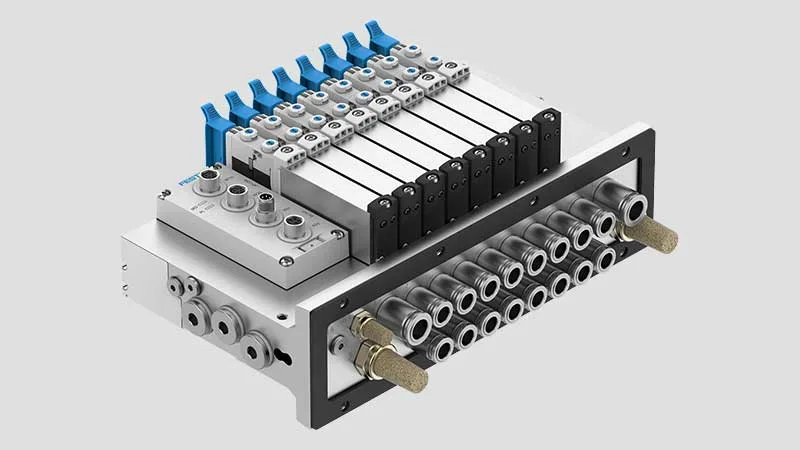
Festo addresses these challenges with its VTUG-EX valve terminal, which brings fieldbus connectivity directly into Class I, Division 2 areas. Using Fieldbus Ethernet, the VTUG-EX can connect directly to a PLC, eliminating the requirement to individually wire actuators across long distances.
The VTUG-EX valve terminal now supports EtherNet/IP, PROFINET, and PROFIBUS communication through interchangeable bus nodes. It can also connect directly to an IO-Link master, providing additional flexibility. The compact VTUG-EX supports up to 24 valve stations, or up to 48 solenoid coils, and delivers flow rates of up to 630 l/min (22 cfm).
Features such as hot-swap valve replacement, multiple pressure zones, and panel-mounted installation help simplify maintenance and system design. Global certifications, including UL Class I, Division 2, and IECEx, support the deployment of the valve terminal in hazardous locations worldwide.
Introducing intelligent automation into hazardous environments is only one part of the overall solution. Machine builders, engineering firms, and system integrators also need to safely distribute power, communication, and control through certified control cabinets designed for hazardous environments. Festo designs, builds, assembles, tests, and certifies complete control cabinets for both hazardous and non-hazardous areas, delivering finished units ready for installation.
Unlike a traditional panel shop, Festo also manufactures most of the automation products installed in these control cabinets, including valve terminals, air preparation, emergency shutdown, and I/O. Since the engineers designing the cabinets understand the capabilities and integration requirements of these components, customers can reduce engineering risk, simplify procurement, and obtain a fully integrated solution from a single source.
This expertise helps ensure that the control cabinet and its automation components operate together as one certified system rather than as individually selected products. Festo’s customers have reduced control cabinet costs by up to 50%.