
A robotics competition hosted this month in Chongqing highlighted China’s push to accelerate the commercialization of embodied AI, showcasing how the technology is progressing from laboratory research to real-world applications.
The finals of the 11th “Maker in China” SME Innovation and Entrepreneurship Contest for Intelligent Biomimetic Robots concluded Sept. 11 in Chongqing’s Shapingba District. The three-day national competition drew more than 100 teams from across China, with projects spanning biomimetic robotics, industrial automation and AI systems designed to perceive and interact with the physical world.
Alongside the competition, organizers arranged meetings involving companies, universities and research institutions, as well as discussions aimed at technology transfer, financing and local deployment. The event formed part of a national program intended to support innovative SMEs with specialized technologies. Its theme was “Pushing Tech Frontiers, Unleashing Creativity.”
The competition comprised 13 tracks, covering work ranging from foundational research to systems approaching commercial deployment. Teams in the startup category competed in three broad areas: cutting-edge technologies, core enabling technologies and specialized applications. Their projects focused in part on the hardware, software and control systems underpinning the next generation of robots.
Teams in the enterprise category, by contrast, tested systems designed for real-world use in the electric power, healthcare and service sectors. The emphasis was on whether the technologies could perform reliably in operating environments and be scaled for broader deployment.
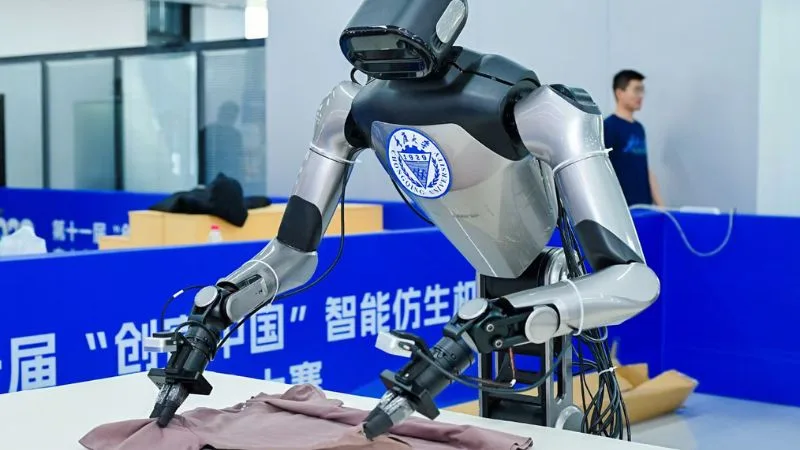
Many of the entries targeted technical bottlenecks that have limited the wider deployment of robotic systems. Projects included multi-robot coordination and task-scheduling systems for warehouses; assistive exoskeletons for older adults and rehabilitation patients; biomimetic robots for inspecting electric power infrastructure; miniature hummingbird-inspired flapping-wing drones; and robots capable of folding clothing autonomously. Together, the projects illustrated the range of engineering approaches Chinese developers are pursuing as they seek practical applications for embodied AI.
The event also provided a platform for investment opportunities and business collaboration, with several participating teams revealing plans to launch operations in Shapingba. During the closing ceremony, the Shapingba District government signed cooperation agreements with SIASUN Robot & Automation Co., Ltd., Chentu Technology, and other enterprises. Separately, ZTE entered into agreements with research teams from Zhejiang University and Xi’an Jiaotong University.
As part of its strategy to become a key hub for embodied artificial intelligence, Shapingba is strengthening its role within Chongqing’s expanding robotics ecosystem. Local government figures show that the district’s robotics industry recorded a 233% year-on-year increase in output value during the first seven months of 2026, highlighting the sector’s rapid growth.