
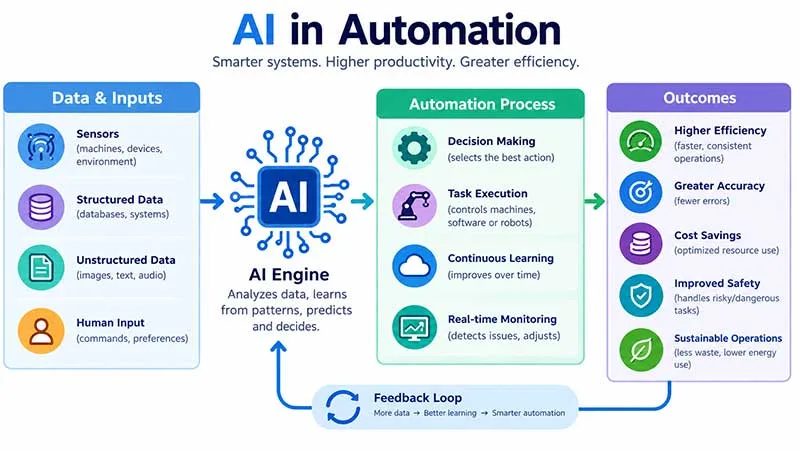
Artificial intelligence (AI) has ushered in a new era of industrial revolution, impacting every industry and its segments. It has impacted factory automation, software development, the PLC market, workflows, and even the active workforce in the industry. AI has forced enterprises and factories to reskill and upskill their workforce. The adoption of Artificial Intelligence by companies globally has optimized processes and made automation adaptive and smart. It has provided a real-time data analyser and installed a decision-maker within a system. The advent of AI, robotics, IoT, and Big Data Analysis gave rise to Industry 4.0, amid the fourth industrial revolution. The rapid progress in Large Language Models (LLMs) and predictive analysis has led to new technological developments in a short period of time.
These factors have contributed to the advent of the Fifth Industrial Revolution, opening the way to Industry 5.0. Again, Artificial Intelligence (AI) holds the centre stage of this development. In this article, we will analyse new developments in AI-induced factory automation, developments in LLMs, the AI automation market, and regulatory mechanisms.
Artificial Intelligence In Factory Automation: New Developments and Trends
There a number of features that AI has brought to the factory automation segment. One of the core features, for example, is predictive analytics. It predicts the future course of action in giga factories by predicting results. The feature has become a breakthrough in factory automation. It aligns with big data analysis and Artificial Intelligence to provide desired output, decrease run time, and lower the cost of maintenance. In this section, we will analyse the new developments in AI-aided automation.
Breakthrough in PLC Segment
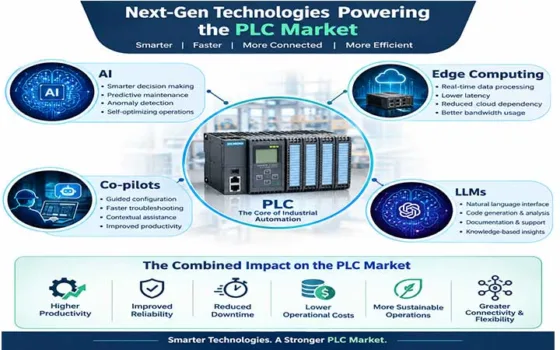
Programmable Logic Controllers (PLCs), which form the core of automation, have gained a new makeover with the advent of Artificial Intelligence. Traditional hard-coded and static PLCs have now been replaced by virtual PLCs (vPLCs). These Programmable Logic Controllers work on AI-aided edge computers, eradicating the need of long distant servers and the distant cloud. It enables the sensors to work in real time with the directions of Artificial intelligence. The AI- and edge-computing-assisted PLCs are redefining the automation landscape, defining the advent of Industry 5.0.
Development of Agentic AI
Traditional factory automation was based on standalone algorithms. The development of AI-aided agents has shifted it to autonomous and software-defined ecosystems. Assisted by edge computing, generative frameworks, and physical robotics, factories have been transformed into closed-loop automated systems.
Bounded-Autonomy Models
The development of bounded-autonomy models has transformed the factory automation space to a greater extent. Under this framework, autonomous AI agents collaborate horizontally across systems. These autonomous agents communicate with each other to detect and start corrective actions to correct the processes. For example, if the machine vision detects any abnormality in a final product, it flags an error and instructs the maintenance agent to start a corrective action.
Development of Zero-code Robotics
The development of Physical AI has led to the transformation of robotics into zero-code robotics. These systems help the robotic arms to learn by mimicking and visually capturing human movement in real time. After learning from them repeatedly, these robots can easily perform physical work such as welding, machining, and palletizing. Foundational models and frameworks like NVIDIA Isaac have introduced architectures for such robots.
Evolution of Predictive Maintenance
The advancements in sensor technology aided by Artificial Intelligence, edge computing, and machine learning, with dynamic Large Language Models, have made it possible to detect future errors. Modern machines, with the help of AI, can forecast future machine failures. Further, it can direct the machines to start maintenance. This ability reduces downtime and helps to save time.
Artificial Intelligence In Factory Automation: Market Forecasts, Drivers and Major Players
According to Grand View Research, the AI Automation market stood at USD 129.9 billion in 2025. The agency projects it to grow from USD 169.5 billion in 2026 to USD 1,144.8 billion by 2033. It is expected to grow at a CAGR of 31.4% from 2026 to 2033. In terms of regional growth, North America held the largest share of 32.7% of the global market in 2025.
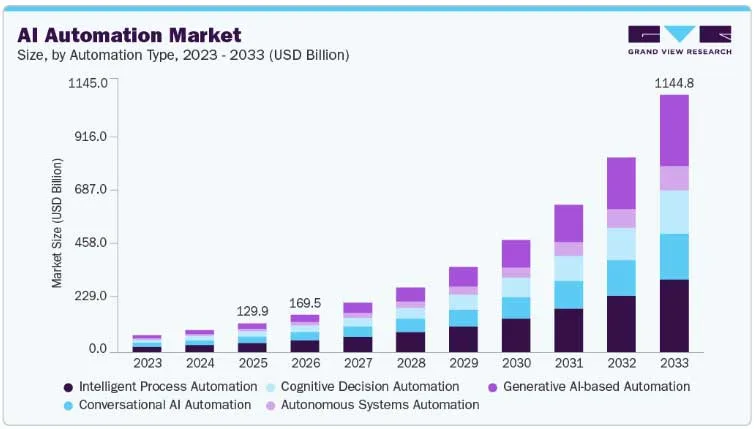
According to Grand View Research, the AI-Automation market is driven by enterprises that deploy AI automation for optimized resource utilization. AI automation is also deployed as intelligent automation systems that support real-time monitoring of energy consumption and operational footprints. These features enable organizations to align business performance with environmental compliance objectives.
Market Drivers
The AI-Automation market is aided by a number of factors. These are:
Cutting Operational Cost
Factories and enterprises across the world are opting to reduce operational costs. Businesses are actively deploying AI automation to cut overhead costs and optimize resource utilization. At the same time, AI-aided automation is helping them to replace manual, repetitive tasks with efficient software.
Generative AI and Agentic AI Integration
In order to resolve complex, multi-step business processes, companies are actively deploying advanced machine learning, generative models, and autonomous AI agents. The rapid deployment of generative AI and Agentic AI has transformed modern factories and increased their productivity.
Digital Transformation Initiatives
Businesses and organizations worldwide are opting for modernization of enterprise workflows. They aim to transition to Cloud-Based Automation for scalability and to integrate modular API frameworks.
Demand for Intelligent Customer Interactions
Companies globally rely on conversational AI, which is well-trained to optimize processes. Virtual assistants and intelligent workflows help to deliver personalized and 24/7 customer engagement.
Regional Insights Into AI Automation Market
According to Grand View Research, North America dominates the AI automation market with a 32.7% revenue share in 2025. High enterprise spending on advanced digital infrastructure accelerates the integration of AI automation across large corporations and mid-sized firms. These firms across the globe are prioritizing intelligent automation to enhance operational resilience and business continuity strategies. Further, data-driven governance frameworks are driving adoption across regulated industries.
United States
According to Grand View Research, the AI automation market in the United States is progressing due to strong venture capital investment in AI startups. These investments are accelerating innovation in advanced automation technologies. The remote and hybrid work models are increasing demand for automated IT service management and workflows.
Europe
The regulatory agencies in Europe are implementing stringent data protection and compliance frameworks. These agencies have been encouraging adoption of AI automation solutions with transparent and auditable processes. Further, the region is witnessing industrial modernization initiatives across manufacturing hubs. Such initiatives support the deployment of intelligent production and quality control systems. Cross-border trade operations increase the demand for automated documentation and logistics management. Public sector digital transformation programs have also contributed to steady market expansion.
Asia Pacific
The Asia Pacific region has recorded the highest CAGR for the forecasted period. This is due to significant demand for cost-efficient AI automation platforms in e-commerce and digital payment systems. The accelerating automation of supply chain and transaction management processes has fueled this growth. Governments across the region have been promoting smart city and digital economy initiatives. These initiatives support broader technology integration. This has led to a rise in the need for scalable cloud-based automation solutions. These are the causative factors for further strengthening regional adoption.
Artificial Intelligence In Factory Automation: Major Players
UiPath Inc.
The company provides an enterprise automation platform and covers robotic process automation, process orchestration, AI, intelligent document processing, and agentic automation. The company helps organizations automate business processes, connect applications, manage digital workers, and coordinate AI agents with the workforce. UiPath serves enterprises across financial services, healthcare, manufacturing, government, and other industries worldwide. UiPath has also introduced UiPath for Coding Agents. It has enabled enterprises to build, test, deploy, operate, and govern automations through coding agents with its orchestration platform.
Automation Anywhere, Inc.
The company is headquartered in San Jose, California, U.S. Automation Anywhere provides cloud-based intelligent automation and agentic process automation solutions for businesses globally. The company’s product portfolio and services support robotic process automation, AI agents, process orchestration, intelligent document processing, and automation. The automation spans finance, IT, customer service, and human resources. The company has recently introduced new platform capabilities for coordinating AI agents, automations, systems, and people across enterprise processes. Overall, Automation Anywhere, Inc. has strengthened its agentic process automation offering.
Microsoft Corporation
The company is a global leader in providing software solutions. The company provides intelligent process automation through Power Automate. This interface combines cloud workflows, robotic process automation, process mining, AI Builder, and Copilot capabilities. Power Automate has the ability to connect business applications and supports automated workflows across Microsoft 365, Dynamics 365, Power Platform, and other systems. The company has added self-healing capabilities to Power Automate in preview, helping desktop automations adapt when application interfaces or conditions change.
SS&C Blue Prism
The company provides enterprise intelligent and agentic automation software. This software helps enterprises and businesses to combine different elements such as AI agents, robotic process automation, workflow orchestration, digital workers, and process management. The company’s product portfolio includes WorkHQ, Blue Prism Enterprise, AI Gateway, Agent Solutions, and Chorus. SS&C Blue Prism focuses strongly on complex and regulated business processes across financial services, healthcare, and other industries. Recently, SS&C has introduced WorkHQ, its enterprise agentic automation platform, which connects AI agents, people, systems, digital workers, and data.
Pegasystems Inc.
The company provides enterprise software for intelligent automation, workflow management, case management, decisioning, customer engagement, and AI-driven process orchestration. Pegasystems has introduced Pega Platform, which combines artificial intelligence and robotic process automation. It also integrates business process management and low-code development to automate complex workflows. The company has recently launched Pega Infinity 26, adding governed agentic AI capabilities for designing, orchestrating, and managing AI agents across enterprise workflows.
Way Forward
The rapid development of Large Language Models (LLMs) has sped up the development of Artificial Intelligence and its integration in factory automation. Its various advantages, as discussed above, have led to its faster adoption across verticals and regions. Edge processing-assisted automation aided by Agentics has broadened the automation portfolio, indicating its brighter future.