

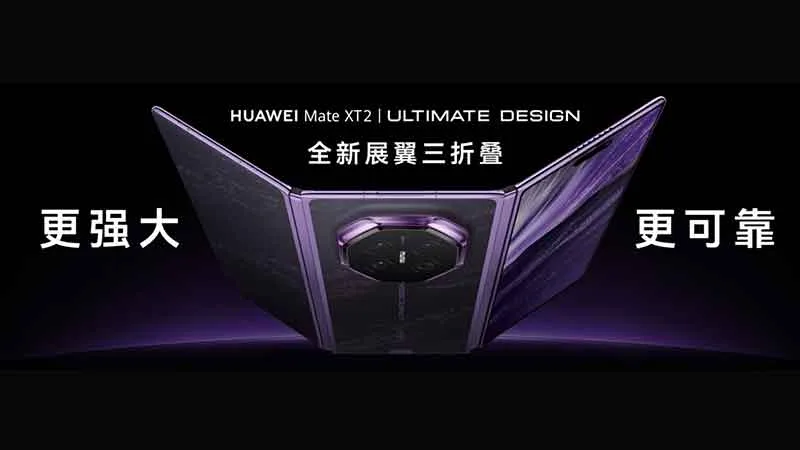
Huawei unveiled the HUAWEI Mate XT 2 | ULTIMATE DESIGN trifold smartphone on September 7. As the first smartphone to operate on HarmonyOS 7, it sets a new benchmark as the industry’s slimmest and largest foldable device. Powered by the Kirin 9050 chipset, the Mate XT 2 also introduces a significant advancement in semiconductor technology. It is the world’s first smartphone equipped with the LogicFolding Tau (τ) Chip, marking the technology’s transition into large-scale commercial production.
The engineering to make this possible is unprecedented. The glass screen must be tough enough to withstand daily use, whilst being able to fold thousands of times. The hinge to allow the screen to fold is the first of its kind. Once open, the handset is just 3.5mm thick. However, the screen is not the only remarkable folding technology in the device.
The first chip with a semiconductor design breakthrough: LogicFolding
The Mate XT 2 Ultimate Design includes a major breakthrough in semiconductor design. The phone is the first to use Huawei’s LogicFolding Tau chip, the Kirin 9050 Pro. Designed by engineers in Huawei’s HiSilicon team, the chip offers a solution to the problem of geometric scaling.
With Moore’s law (the historical observation that the number of transistors on a microchip doubles approximately every two years) believed to be reaching its physical limit, making chips smaller is becoming more challenging and costly.
For Huawei, faced with external restrictions, the need to find a solution came sooner than expected.
In May this year, He Tingbo, President of Huawei’s HiSilicon division, unveiled a new way of designing and making chips, alongside a new law to measure their performance, the τ (Tau) Scaling Law. The work led to Ms He being recently named one of the world’s leading AI innovators by Time Magazine.
The point of shrinking transistors was never the smallness itself, it’s what the smallness delivered. Shoppers looking to buy the latest smartphone don’t care if the chips inside have 7, 5 or even 2-nanometer nodes, they care about the performance of the device in their hands. What matters to consumers is the time it takes for a task to be completed, a video to be shared or a game to load. The performance of the chip should be measured in the same way: by time, not size. This is why Huawei proposed τ (Tau) Scaling Law as an alternative to Moore’s Law.
Breaking through barriers to improve performance
The Kirin 9050 Pro uses 3D integration to boost performance. Traditional chip advancement focussed on packing more and more transistors into a linear plain by making each one smaller. LogicFolding uses 3D integration to reduce the distance between transistors by stacking them on top of one another, increasing the number of transistors whilst reducing the distance between them.
In fact, in the Kirin 9050 Pro transistor density has risen from approximately 155 to 238 million transistors per square millimetre. That’s an equivalent increase to what was achieved in the previous three years using geometric shrinking.
It was thought that stacking active transistors on top of each other and sealing them inside a solid mobile device would present an engineering challenge. Power turns into heat, which in a confined space would raise the temperature and ultimately break the device.
The key to the solution came in recognising that integrated chips have both transistors and circuits. As He Tingbo explains in her IEEE article, Huawei’s τ Chip Was Supposed to Melt?, the inner workings of a chip can be compared to an office worker’s day of work. Many office workers will use more energy on their commute to and from the office than they do at their desk because they are moving around more on the road. The ‘work’ part of their day is not the most energy-intensive part, as they are often seated at their desk.
The same is true for chips. The most energy-intensive part of the process is the ‘commute’, moving data from point A to point B, not processing it. Integrated circuits use power in two main ways. The first is switching, flipping a transistor gate to change a bit from 0 to 1 and back. The second is the transmission of that data, moving the bits from one part of the chip to another.
This is important in mobile phones where a lot of performance requirements are asked of a single chip. Equally, however, in a large AI cluster, 80% of the energy is used in moving the data, not processing it. In both cases, LogicFolding reduces the space between transistors, which in turn reduces the power used. The previous assumption that packing transistors on top of one another would increase the heat turned out to be false. In fact, even with a higher transistor density per millimetre, LogicFolding chips run cooler per unit of work. The result is Huawei’s most powerful smartphone ever.
The first phone to run HarmonyOS 7
The Mate XT 2 is the first smartphone to run HarmonyOS 7. Forty-two percent more powerful than the previous generation, it remains the slimmest and largest foldable display in the industry when open. The cover screen spans 6.5 inches, boosting the screen-to-body ratio from 86.4% to 92.8%. Enhanced with 70% better anti-reflection, the screen exhibits a deeper, cleaner black when off, and pure, crystal-clear transparency when lit.
The Huawei Mate XT 2 also introduces the world-first Smart Shield Privacy Screen on a foldable screen. Two independent pixel sets co-exist within the 10.2-inch display at a micro-pitch of just 9 μm. When Privacy Mode is activated, the screen seamlessly switches from a wide viewing angle to a narrow one while maintaining identical resolution and clarity, protecting your privacy in public spaces without compromising your view.
Industry-first ECG analysis
Health tech is increasingly important to consumers, and so the Mate XT 2 is the industry’s first smartphone to introduce ECG analysis. Capitalising on the innovative tri-fold form factor, users can simply hold both side frames with both hands while unfolded to capture a 30-second ECG signal. Paired with the medically certified analysis software, it generates detailed ECG reports to help identify Sinus Rhythm, Atrial Fibrillation, and Premature Beats.
The launch of the Mate XT 2 represents an important milestone in Huawei’s ongoing evolution. Driven by substantial investment in research and development, the company continues to deliver innovations that are shaping and redefining the industry. More than half of Huawei’s workforce—over 100,000 employees—is dedicated to R&D. Globally, the company currently holds around 160,000 active patents. During the first half of 2026, Huawei invested more than RMB 121 billion in R&D, equivalent to 25.94% of its revenue and representing a 25.2% year-on-year increase.