
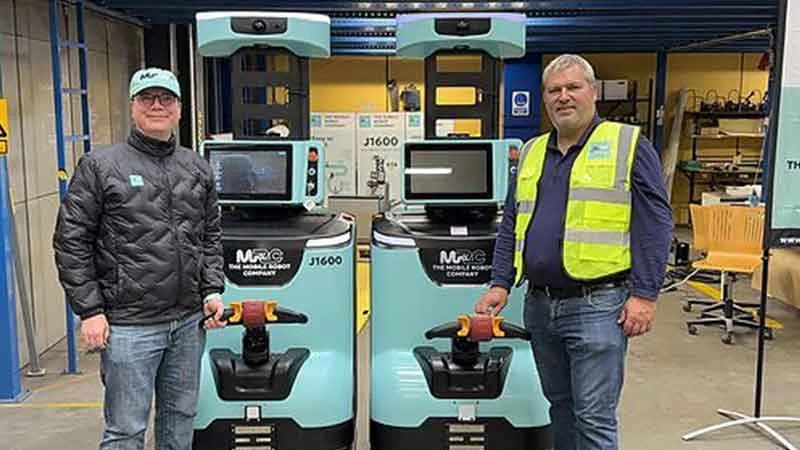
Forty-eight hours before their startup’s most critical public appearance, Emil Hauch Jensen and Odin Kudahl Skovsted faced a late-night crisis. The two founders of The Mobile Robot Company had a robot suddenly failing its own safety checks. It was April 2026, and their debut at TEST CAMP INTRALOGISTICS in Dortmund was looming.
“We were in extreme panic.”
–Jensen, the company’s CEO
Out of time, the team loaded the immobilized robot into a truck at 6:00 p.m. and drove through the night from Copenhagen to Dortmund, hoping for a breakthrough on the road. That breakthrough arrived the very morning of the setup: a call from their supplier with a last-minute fix that finally cleared the error, pulling the startup back from the brink of a high-profile disaster. In June 2026, that same machine—a self-driving pallet jack named the J1600—shocked the industry by defeating manufacturing giants to win the prestigious IFOY Award for Industrial Truck of the Year.
It was a dramatic validation for a company launched nineteen months earlier, in November 2024. Jensen and Skovsted are no strangers to robotics, having collectively deployed over 10,000 robots during previous tenures at Mobile Industrial Robots (MiR). Skovsted ran technical support, while Jensen spearheaded MiR’s expansion into China. Through daily problem-solving, the pair bonded over a shared frustration: the excruciating difficulty of making fully autonomous robots work perfectly in unpredictable warehouses.
“We found that it’s the last five and ten percent that are the hardest and the most expensive and require a lot of custom engineering”
– Jensen
That realization crystallized into The Mobile Robot Company, an enterprise built on a counter-intuitive premise. Instead of chasing 100 percent autonomy, Jensen and Skovsted decided to deliberately target 80 percent.
The catalyst for this philosophy came during a visit Jensen made to an Amazon distribution center. Given Amazon’s relentless drive for efficiency, Jensen expected an automated marvel. Instead, he found a facility devoid of mobile robots. An operations manager explained that their processes changed ten times a week to adapt to evolving customer demands. Full automation was too rigid.
“It wasn’t a cost issue. It was really the flexibility, the need to be able to very quickly adapt the processes.” He realized that keeping a human in control, rather than ceding total authority to a software system, was the key to unlocking widespread adoption.”
-Jensen
That insight became the foundation for the J1600 self-driving pallet jack. It features a “dual-mode” capability, acting as a conventional, tiller-controlled manual electric pallet jack when handling nuanced, judgment-heavy tasks, and seamlessly transforming into an autonomous robot for repetitive, long-distance floor transport.
Warehouse environments are notoriously messy. Damaged pallets, unstable loads, steep dock plates, and stray shrink-wrap require human intuition. By leaving pallet pickup and exception-handling to human operators, The Mobile Robot Company bypassed the nightmarish complexity of full integration. Once a worker manually secures a load, they use a touchscreen to select a saved destination and initiate the autonomous sequence. The J1600’s dual-mode system takes over the tedious walking, navigating via 3D LiDAR SLAM technology.
Today, the Copenhagen-based company operates a rigorous testing facility intentionally designed to mimic the imperfect reality of industrial floors, complete with uneven surfaces and unpredictable obstacles. The startup remains lean, having grown from six employees in January 2026, when the first J1600 drove autonomously, to nine employees today. Yet, their impact has vastly outpaced their headcount. Through a rapidly expanding network of distributor partners, the company now operates across eight countries in the EMEA region and is eyeing further international expansion.
Incumbent forklift manufacturers can certainly attempt to copy the dual-mode concept, but Jensen believes the startup’s competitive moat lies in its exceptional software and relentless focus on the user experience. By empowering warehouse operators rather than trying to replace them, the J1600 has sidestepped the typical anxieties surrounding automation. The moment operators realize the machine is a tool that saves them miles of walking rather than a threat to their livelihoods, skepticism evaporates.
“I welcome more people to join the dual-mode future. They help us get from 1% automation to 99% automation,”
-Jensen
For Jensen and Skovsted, the journey from managing endless integration headaches to standing on the stage in Stuttgart with the Industrial Truck of the Year award has been a whirlwind of exhaustion and vindication. The Mobile Robot Company has proven that sometimes the smartest way to advance industrial automation is not to make the robot do everything, but to let it do just enough.