
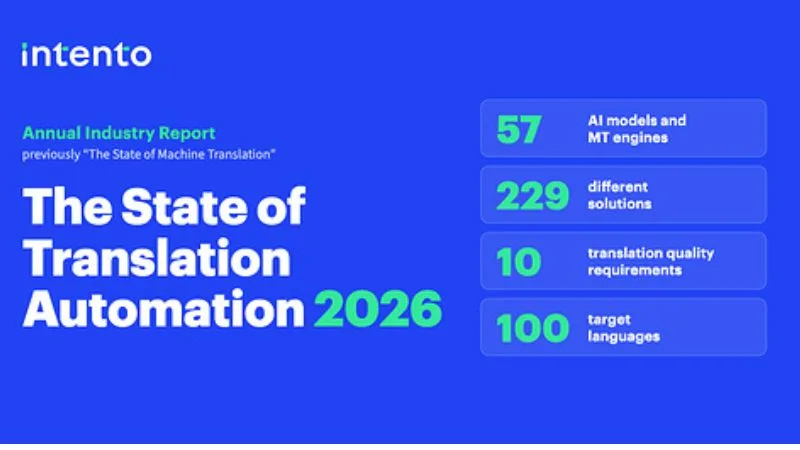
Intento has released The State of Translation Automation 2026, an interactive report designed to help users identify the most suitable AI translation solutions for their specific needs across 100 languages. Readers can select their translation requirements, choose a target language, and prioritize quality, cost, or speed to explore which solutions best match their goals and compare their performance.
For this report, Intento’s language engineering team tested 229 translation solutions powered by 57 AI models and machine translation (MT) engines. The evaluation covered translations from English into 100 languages, measuring performance against 10 translation requirements across three levels of quality.
- Basic: general translation quality.
- Standard: Basic plus terminology, tone of voice and six formatting requirements, such as tag handling, valid JSON and Unicode support.
- Advanced: Standard plus gender neutrality.
Each solution combines a model with a harness: prompts, glossaries and other context, and pre- and post-processing. For each language, the team started with an off-the-shelf model and added steps only when a simpler solution could not meet the requirements. This is the same approach Intento uses for clients.
“Automating translation used to mean choosing the ‘less wrong’ machine translation model for your content and language pair. Now it means building a harness around the models that meets your translation requirements, and you can’t build one without evaluations that check each requirement. In the report we build solutions the way we do for our clients, starting with the simplest one and adding steps only where it falls short, and show for each language what it takes in quality, cost and translation time.”
-Konstantin Savenkov, CEO & Co-founder of Intento
The 57 models come from 37 vendors, including Alibaba, Amazon, Anthropic, Cohere, DeepL, DeepSeek, Google, Microsoft, Mistral, OpenAI, Tencent, and xAI, and include neural machine translation models, MT systems based on large language models (LLMs), and commercial and open-weight LLMs.
The team evaluated off-the-shelf models and models adjusted with glossaries, tone of voice instructions and tag handling. It also tested two-step solutions that translate and then post-edit with an LLM, three-step solutions that translate, assess quality and repair errors, and multi-agent systems for advanced translation requirements.
AI translation quality depends on the language, the requirements and the workflow around the model
- More demanding requirements leave fewer languages with a one-step solution plus a qualifying backup. For Basic translation quality, 54 of the 100 languages have this combination. That number falls to 38 languages for Standard quality and 12 for Advanced quality. The backup may require additional steps. In 18 languages, automated checks are not reliable enough to assess every requirement.
- Additional steps help LLM solutions meet the general translation quality requirement. Among the evaluated LLM solutions that initially fall short, 24% meet it after translation and post-editing, and 60% after translation, quality assessment and repair.
- Real-time translation comes with a quality trade-off. None of the real-time one-step solutions assessed in 84 languages meets every Standard requirement. Across the 38 languages where a one-step solution does meet those requirements, the fastest qualifying solution takes a median of about 65 seconds per 1,000 source words.
Methodology
Between June and September 2026, language engineers at Intento translated four English business texts totaling 2,978 words into 100 languages: an editorial article, a legal privacy notice, an institutional mission statement and planning guide, and a travel-safety alert.
Two automated quality-estimation metrics were used to shortlist 10 to 13 solutions per language. Intento LQA then assessed the shortlisted translations against the 10 requirements. Three LLM judges from three vendors identified errors by type and severity, and a fourth LLM combined their anonymized findings. The team accepted a result only where the three judges agreed on at least 90% of sentences. The six formatting requirements were checked in code.
Costs use August 2026 list prices in US dollars per million characters of the English source. The same language engineers configure AI workflows for more than 60 enterprise customers across hundreds of language pairs.
Intento empowers global enterprises to streamline multilingual communication through intelligent AI-powered translation automation. Its Enterprise Language Hub combines a patented AI routing technology with a sophisticated network of AI agents to manage translation across websites, applications, help centers, customer support, and internal platforms in 650 languages.
Powered by more than 50 specialized large language models (LLMs), these agents go beyond translation to evaluate, refine, and correct content in line with each organization’s unique requirements, including terminology, brand voice, formatting, and compliance standards.
From defining language requirements and designing quality workflows to integrating translation processes into existing systems, Intento’s language engineering team manages the entire implementation journey. This enables enterprises to deploy advanced AI translation solutions without requiring in-house AI expertise.
The outcome is a scalable, end-to-end translation ecosystem that helps global businesses expand multilingual operations with greater consistency and efficiency. Today, Intento supports more than 60 global enterprises, including Indeed, Hexagon, Strava, and Agilent.