
With Industry 5.0 knocking at the door, and with the advancement of Artificial Intelligence, the Internet of Everything (IoE), advanced sensors, and robotics, the Programmable Logic Controller (PLC) has remained the backbone of the automation sector. Be it different types of sensors, push buttons, or proximity switches, the industrial automation segment becomes animated only after PLCs function. Robotics, automation, and Artificial Intelligence, coupled with PLCs, have ushered in a new era of productivity in industries. In this article, we will be analysing the new innovations, latest trends, market, and regulation in the Programmable Logic Controller Space.
Programmable Logic Controller: New Innovations and Trends
With the advent of Industry 5.0, the traditional logic controllers have evolved from traditional PLCs to intelligent, smart, connected, and software-defined logic controllers. There are certain advancements in PLC design and control architecture. These new innovations and trends have been covered in this section.
Software-Defined PLCs
The development of computer-oriented architectures across the industry with app-assisted modules has led to the development of software-defined PLCs. These PLCs are based on virtualization technologies. This technology uses applications to implement PLC logic control functions. Such technologies integrate Artificial Intelligence (AI), edge computing, and cloud networks. There are two main types of such PLCs.
Virtual PLC (vPLC)
It is a software-based programmable logic controller. vPLC runs on general-purpose computers, edge servers, or cloud instances instead of dedicated physical hardware. These PLCs are based on a decoupled architecture, where control logic is separated from physical hardware.
Advanced Language-Based PLCs
These PLCs support standards like Structured Text (ST) and Function Block Diagrams while using the traditional ladder logic for complex tasks. These PLCs utilize standardized high-level text and graphical languages that are defined by the IEC 61131-3 standard to execute complex automation tasks.
AI-Integrated and Edge Computing-Assisted PLCs
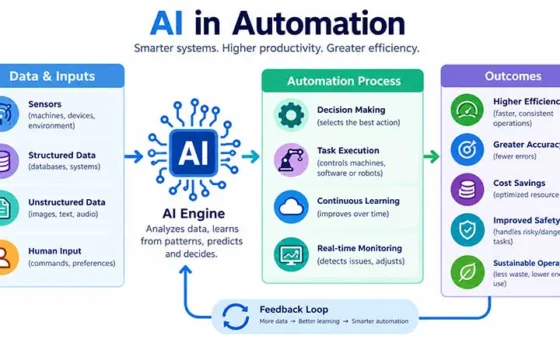
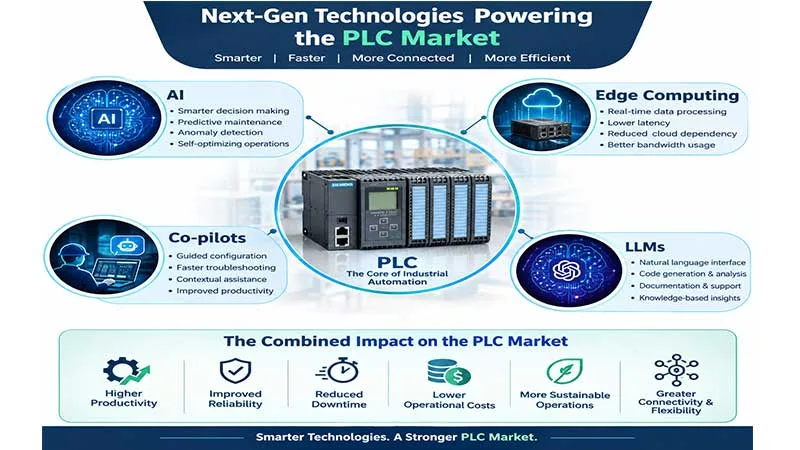
Modern programmable logic controllers use machine learning to analyze operational patterns. These controllers also run predictive maintenance before equipment fails. The integration of Artificial Intelligence (AI) transforms static, pre-coded industrial systems into adaptive, self-optimizing architectures. The advanced development of AI has further expanded the automation sector by using advanced PLCs.
Traditional PLCs have very low memory and storage capacity. The integration of edge computing with PLCs has increased their efficiency and optimized their functions. Edge processing involves local data processing. It reduces latency for critical manufacturing steps without constantly relying on a cloud connection.
Further, the integration of Large Language Models (LLMs) has ignited a revolution in the programmable logic controller segment. It has reduced the software development cycle, lowered the engineering cost, and filled the skill gap by providing efficient solutions.
The generation of visual languages like Ladder Diagrams (LD) poses a significant challenge to the development of the PLC market. This hindrance is due to their graphical nature, which requires significant human intervention. The modern LLM workflows (such as Spec2Control) are increasingly translating textual control narratives into Function Block Diagrams (FBDs). These architectures use standard target formats like PLCopen XML for effective PLC programming.
Development of Industrial Co-Pilots
The latest development in the Programmable Logic Controllers (PLCs) sector is the development of industrial co-pilots. As the Generic AI coding assistants fail in industrial environments due to a lack of physical hardware context and strict real-time safety enforcement. This has led to the development of commercialized, fine-tuned, specialized LLM tools. For example, Siemens Industrial Copilot renders real-time data. It also troubleshoots syntax errors and helps automatically generate human-machine interface (HMI) visualizations directly inside engineering suites.
Similarly, Schneider Electric has developed a copilot called EcoStruxure Copilot. It embeds pre-validated PLC libraries, proprietary hardware constraints, and safety guidelines directly into the code generation cycle. Companies such as ABB, Rockwell Automation, and Mitsubishi Electric have developed co-pilots assisted by generative AI-powered LLMs.
Programmable Logic Controller: Market Analysis, Market Drivers and Key Players
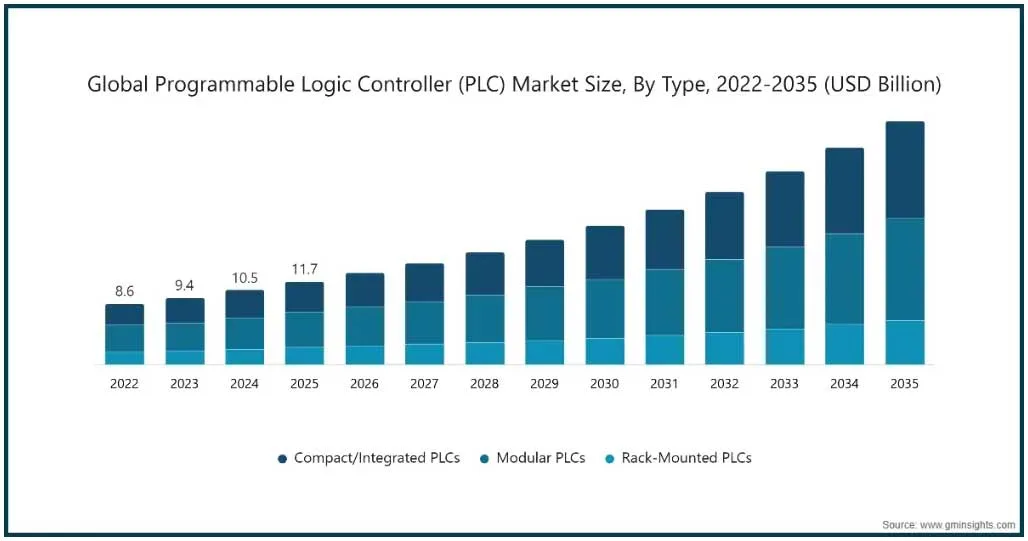
According to Global Market Insights, the Programmable Logic Controller (PLC) market stood at $11.7 billion in 2025. The agency estimated the market to reach $12.9 billion in 2026. Further, according to the agency, the PLC market will reach approximately $34.2 billion by 2035. During this period, the agency will showcase an approximately 11.4% CAGR from 2026 to 2035.
Key Market Drivers
According to Global Market Insights, the convergence of deterministic machine control with software, industrial connectivity, and cyber-resilient plant architecture reshapes PLC demand. There is constant upgrading of programming languages. For example, the current IEC 61131-3:2025 updates the programming-language framework used in programmable controllers. It reinforces the role of common engineering environments as plants connect control systems with edge applications and higher-level production systems. Hence, the procurement of PLCs depends on a number of factors such as lifecycle engineering tools, interoperability, and security controls. The ability of the PLCs to upgrade an installed asset without disrupting validated production processes is another requirement by the production managers.
The adoption of automation across different industries has increased the demand for PLCs. These industries are adopting PLCs in different segments, co-pilots, AI, and edge computing-aided software updates to increase operational efficiency and optimal growth. The following sectors have shown a significant demand for Programmable Logic Controllers (PLCs).
Automation in Electric Vehicle Segment
There has been a rampant adoption of automation across the Electric Vehicle Automation segment. These production facilities require coordinated welding, material handling, assembly, inspection, and safety functions across a large number of stations. Recently, KUKA installed a battery-pack assembly deployment at FAW-Volkswagen’s MEB Smart Factory in Foshan. This example demonstrates how highly automated battery production embeds control requirements. PLCs provide distributed control, safety functions, motion coordination, and repeatable engineering libraries. Hence, such installations provide a level playing field for the PLC market.
Development of Industrial Software and Interoperable Control Architectures
PLCs have the ability to connect legacy equipment to manufacturing applications without compromising real-time control. There has been constant evolution in research on low-code integration of legacy PLC systems. This integration identifies interoperability layers as a practical route for bringing established equipment into Industry 4.0 environments. For Example, IEC 61131-3:2025 supports a common programming foundation. At the same time, it reflects the broader move toward engineering environments that accommodate both established control languages and higher-level software workflows.
Renewable Energy and Grid Automation
There has been a constant demand for Programmable Logic Controllers (PLCs) in Renewable plants that require supervisory control for different tasks. The whole operation requires inverter coordination, protection interfaces, asset monitoring, and grid-code compliance. By August 2024, ABB’s AC500 PLC-based automation solutions had surpassed 10 GW across more than 300 renewable-energy projects in India. The common monitoring and operating architectures provide a fair playing field for PLCs in this segment.
Programmable Logic Controller: Key Market Players
Siemens AG
The factory automation segment under the Digital Industries sector of Siemens AG holds the Programmable Logic Controller (PLC) portfolio. The company has a significant market share in the PLC market. SIMATIC controllers, the company’s legacy PLC hardware, act as its nervous system for Siemens’ automation loop. Siemens AG has dominance in the high-margin PLC software segment too. The company has a diverse product portfolio in this section in the form of TIA Portal (Totally Integrated Automation) software and its PLM (Product Lifecycle Management) cloud. The company has an estimated global share of 30% – 33%.
Rockwell Automation
The company is the second-largest market share holder after Siemens AG. It has a total share of 22% – 25% of the global PLC market share. The company, under its Allen-Bradley brand, offers a comprehensive portfolio of Programmable Logic Controllers (PLCs) and Programmable Automation Controllers (PACs). These PLCs can be scaled from standalone smart relays to enterprise-level process and safety systems. For small and standalone machinery, the company offers the Micro800 Series and MicroLogix Series PLC lines. For Machine and Line control, the company has the CompactLogix Series and SLC 500 Series. The company also offers solutions for Enterprise & Large Control Systems. In this category, it has innovative products in the form of the ControlLogix Series, GuardLogix Series, and PLC-5 Series. The company also offers software solutions such as Studio 5000 Logix Designer for process optimization and increased efficiency.
Mitsubishi Electric
The company has a wide range of products in the programmable logic controllers segment. Under its industrial automation category, the company’s product portfolio features a comprehensive range of controllers, software, and modular systems, helping with factory automation. Under its MELSEC Series, the company provides MELSEC iQ-R Series, MELSEC iQ-R Series, MELSEC-Q Series, and MELSEC-F & A Series. Mitsubishi Electric also provides a range of motion controllers, SCADA software, and Graphic Application controllers to the industry.
Schneider Electric
Modicon line, the brand that pioneered the very first programmable logic controller, is part of this group. The product portfolio of the company scales from entry-level smart relays to IIoT-native Edge Programmable Automation Controllers (ePACs). These controllers are integrated into the EcoStruxure architecture. In its Industrial Machine and Logic Controllers portfolio, which consists of Micro/Medium PLCs, the company offers controllers such as Modicon M221, Modicon M241, Modicon M251, and others. For process automation & infrastructure controllers which requires high end PACs, the company provides Modicon M580 ePAC, Modicon M340, and others. The company’s product portfolio also includes specialized controllers, and Smart relays, and Automation Software Suites.
ABB
The ABB PLC and Automation has a diverse range of product portfolio, starting with the flagship AC500 PLC platform, a highly unified, modular, and scalable architecture. The company provides solutions ranging from compact machinery to massive process infrastructure. The product portfolio of the company includes Programmable Logic Controllers (AC500 Series), AC500 (Standard), AC500-XC (Extreme Conditions), AC500-S (Safety), etc.
Regulatory Compliance For Programmable Logic Controllers
PLC manufacturers need a diverse range of compliance requirements that are based on internationally defined standards. These standards have been categorized into various subsets, such as Key Safety and Design Standards, Cybersecurity and Network Compliance, and others.
Safety and Design Standards
The following safety and design protocols have been set.
IEC 61508
It is the foundational international standard for the functional safety of electrical, electronic, and programmable electronic safety-related systems.
IEC 61511 & IEC 62061
This standard is a sector-specific functional safety standards. While IEC 61511 governs safety instrumented systems in the process industry, IEC 62061 applies to machinery safety.
IEC 61131-3
This standard provides programming languages and standardized frameworks for consistent, reliable control logic configuration.
IEC 61010-2-201
This standard specifies safety requirements for industrial control equipment and harmonizes global certification rules.
Cybersecurity and Network Compliance
IEC/ISA 62443
This standard is the core framework for securing industrial automation and control systems (IACS) against cyber vulnerabilities.
NIST SP 800-82
This framework outlines guidelines for industrial control systems (ICS) security. It focuses on threat analysis, access control, and network segmentation.
Way Forward
The PLC automation market is expanding with a massive CAGR, owing to fast adaptation in automation, changing market dynamics in robotics, and precision requirements in manufacturing. The adoption is well fuelled by high-level R&D by top companies, decreasing downtime, and increasing efficiency requirements. Overall, international compliance requirements, the advent of Artificial Intelligence, Predictive Maintenance, and Large Language Models have provided the PLC market with an upthrust, showcasing a brighter future for the PLC Market.