
KUKA Robotics will showcase its advanced automation solutions for a range of packaging operations and food manufacturing applications at Pack Expo 2026, taking place from Oct. 18-21 at McCormick Place in Chicago, Ill. At booth #N-5530, the company will present live demonstration cells representing real-world applications in collaboration with its system partners, including the Compendium Group, FOCUS Integration and Acieta. KUKA will also feature an interactive podium where visitors can experience the company’s LBR iisy cobot paired with the advanced iiQKA.OS2 robot operating system.
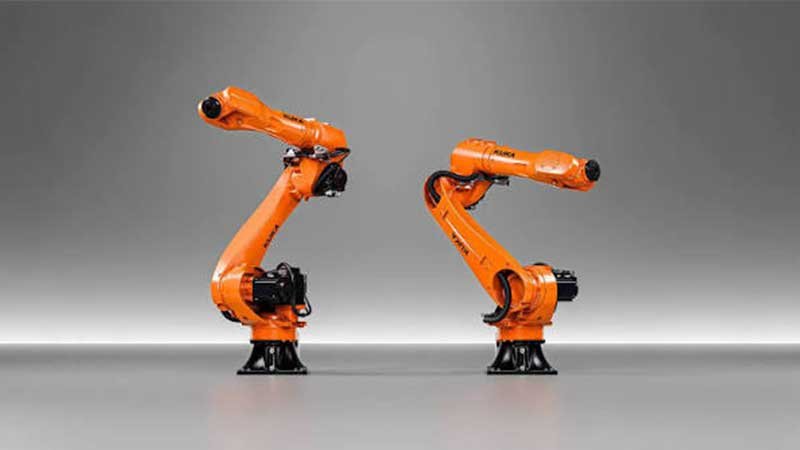
KUKA System Partner Compendium Group will demonstrate robotic case erecting using two compact KR AGILUS six-axis robots. The two robots will work together, with one holding a carton while the other loads a cardboard insert, demonstrating fast and precise handling for high-speed packaging operations. Compendium programmed the cell with KUKA. PLC mxAutomation programming software, which supports intuitive robot programming directly within the PLC environment, simplifying integration, speeding up commissioning and offering greater flexibility.
As a universal PLCopen-certified PLC interface, KUKA.PLC mxAutomation enables users to program and operate all key robot functions directly through their familiar control environment. In addition to sending commands to the robot, the interface allows diagnostics and status information to be transmitted back to the controller.
For a material handling application, KUKA System Partner FOCUS Integration will showcase its double-sided CUBE robotic palletising and depalletising cell. The system is equipped with a KR IONTEC industrial robot and a KMP 1500P autonomous mobile robot (AMR), which transports pallets to create a seamless automated workflow. The double-sided configuration supports uninterrupted production and increased throughput by autonomously removing completed pallets while palletising continues on the opposite side. The cell features KUKA’s iiQKA.OS2 operating system, the KR C5-2 controller and iiQWorks.Sim simulation software.
The iiQKA.OS2 operating system is scalable and customisable and features a complete virtual robot controller (VRC). Its AI-capable controller enables users to address new ISO 10218:2025 and cyber-resilient requirements for future-ready digital manufacturing.
KUKA’s KR C5-2 robot controller system provides tailored controller solutions for a broad range of applications involving industrial robots and additional kinematic systems. Its custom-fit combination of controller modules, interface modules, peripheral modules and a scalable cabinet system enables integration into diverse automation environments.
Using iiQWorks. Sim, FOCUS programmed, tested and optimised the cell’s KUKA industrial robots offline before deployment. The simulation software supports robot simulation, process validation and virtual commissioning, helping reduce risk, improve efficiency and accelerate project implementation without interrupting ongoing production.
For case blank loading in packaging applications, the Acieta cell demonstration features a KR20 R1820 robot from KUKA’s KR CYBERTECH series. The robot has a compact design that supports high integration density and reduced interference contours. In the application, the KR CYBERTECH removes straps from bundles of flattened boxes and then loads the boxes into the magazine of a case erector.
As an interactive experience at Pack Expo 2026, KUKA will present its LBR iisy cobot alongside the company’s iiQKA.OS2 operating system. The LBR iisy is designed to be versatile, intuitive to operate, and reliable for applications involving direct interaction with humans. Suitable for all production areas, it combines industrial automation expertise with the flexibility and simplicity of an intelligent tool, along with the speed of a traditional industrial robot.
The iiQKA.OS2 operating system features a modern user interface and modular safety while supporting the simulation of multiple robots and their peripherals. Drawing on decades of KUKA development experience, the operating system uses the latest web technologies to provide expanded functionality, an enhanced user experience and streamlined workflows. It can also identify errors at an early stage through engineering functions such as simulation, offline programming and comprehensive virtual-environment testing, helping to significantly reduce risk and overall costs.