
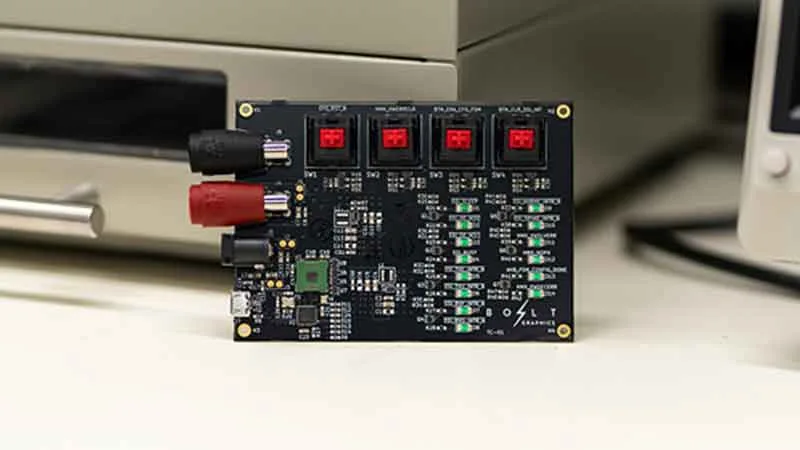
Bolt Graphics, Inc. (Bolt), a fabless semiconductor startup specializing in hardware and software solutions for high-performance computing (HPC), rendering, and digital twin applications, has announced the successful bring-up of its Zeus test chip and the establishment of a new office in Taipei. The office will oversee manufacturing collaborations as the company advances toward the launch of its first commercial GPU, which is targeted for general availability in 2028. Developed using TSMC’s 12nm process and based on Bolt’s rendering technology architecture, the Zeus test chip combines hardware and software acceleration for electromagnetic simulation and path tracing. These capabilities are designed to support comprehensive product simulations without requiring physical prototypes, helping streamline development and testing processes.
Bolt’s unique graphics processing unit (GPU) exceeds performance expectations, validating the innovative chip architecture. Bolt has successfully proven that highly complex physics algorithms can be executed using fixed-function hardware, which accelerates the training of advanced robotics and world models. The Zeus test chip is the first commercial GPU architecture with dedicated electromagnetic simulation hardware. This addresses the performance, accuracy, and memory limits that historically prevented CPU- and GPU-based software from simulating complete products and is essential for the development of silicon photonics as well as research into new materials, optics, and stealth geometries.
“For years, engineers have had to choose between simulating individual components or building a physical prototype of complete products. Running Maxwell’s equations on our silicon eliminates that tradeoff. Electromagnetics is our starting point, and the goal is to let users accurately simulate anything in the world by building a complete physics simulation solution.”
– Darwesh Singh, Founder and CEO of Bolt Graphics
General purpose CPU and GPU constraints limit electromagnetic simulation, computational fluid dynamics (CFD), and molecular dynamics. Bolt aims to accelerate all three, so engineers and scientists can accurately simulate and render highly complex parts and products, as well as training robots and world models.
Test Chip Results and Celebration
The test chip was brought up in 24 hours. Bolt powered on and tested the A0 silicon with no functional issues, performing tests across a range of -40 C to 85 C. The 6 sq mm chip runs at 1.4 watts, compared with 35 watts for the FPGA platform (a reprogrammable prototyping platform), exceeding internal performance and efficiency estimates. The initial tape-out was completed in April.
Taipei Office
Bolt has established an office at Taipei Nanshan Plaza, bringing its team closer to suppliers as it prepares its flagship Zeus GPU for volume production. The office already has team members in place, and Bolt plans to scale headcount there rapidly to deliver production silicon. Bolt was also selective in choosing its process node, TSMC’s N5P, to avoid competing for wafer allocation. Bolt expects to open developer access in the first quarter of 2027, with initial Zeus GPU availability to Early Access Program customers planned for late 2027. Volume production of PCIe cards and servers is expected to follow in 2028. With the technology validated in silicon, Bolt is strengthening its relationships with partners as customers anticipate access to Zeus.
“Building production silicon takes close coordination with our partners. Having our team in Taipei puts us beside our key suppliers, allowing us to keep a pulse on the progress and move faster while ensuring quality is maintained throughout development.”
– Lawrence Lee, VP, Manufacturing Operations at Bolt Graphics
Bolt Graphics is building a next-generation compute platform designed to dramatically improve cost efficiency across high-performance computing, rendering, and emerging workloads. By optimizing for performance-per-dollar, the company unlocks new applications and promises to become a foundational layer for the future of compute.