
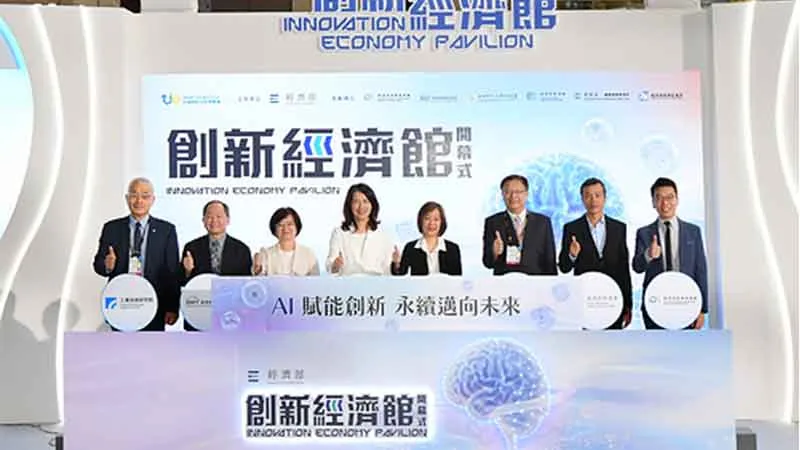
The Taiwan Innotech Expo (TIE) 2026, a leading platform for showcasing groundbreaking innovations, officially opens on September 17 at Exhibition Hall 1 of the Taipei World Trade Center. At the Innovation Economy Pavilion, the Department of Industrial Technology (DoIT) under Taiwan’s Ministry of Economic Affairs (MOEA) has joined forces with more than 13 research institutions and industry partners to showcase 64 innovative technologies.
Among the featured innovations is the 3.2T Silicon Photonics (SiPh) Optical Engine Technology, developed by the Industrial Technology Research Institute (ITRI) with support from DoIT.
As demand for AI computing continues to surge, the volume of data moving through data centers is also growing rapidly, pushing conventional copper interconnects toward their bandwidth limits. The challenge is comparable to traffic overwhelming a city’s roads: adding more lanes helps only so much. A fundamentally more efficient way of moving data is needed.
ITRI’s 3.2T SiPh Optical Engine Technology addresses this challenge by using light rather than electrical signals to transmit data through multiple integrated high-speed channels. It delivers a total transmission capacity of 3.2 Tbps, or approximately 400 GB per second—twice the capacity of the previous 1.6T generation and equivalent to the data volume of about 20 4K movies. Light-based transmission also reduces signal loss and heat generation compared with conventional copper interconnects.
To accelerate commercialization, ITRI has assembled a network of more than 20 supply chain partners spanning chip design, fabrication, testing, and packaging. ITRI has also collaborated with international companies to advance specifications for 3.2T technology. These efforts are strengthening Taiwan’s competitiveness in the global AI optical communications supply chain.
DoIT-supported innovation is also addressing pressing healthcare needs. Taiwan has nearly 97,000 dialysis patients and one of the world’s highest dialysis rates relative to population. Among the various uremic toxins, middle-to-large-molecule toxins are known to be closely associated with chronic inflammation, cardiovascular disease, and other health risks.
Conventional testing requires blood samples to be collected before and after dialysis and sent to a laboratory for analysis. Results take three hours and often become available only after the treatment session has ended, limiting physicians’ ability to make timely adjustments.
To address this problem, ITRI has developed DiaTrack, a middle-to-large-molecule uremic toxin detection technology, also with support from DoIT. DiaTrack connects directly to a dialysis machine’s effluent port and analyzes toxin types and concentrations every 15 minutes. This gives physicians timely insight into toxin clearance while treatment is underway and provides data to support personalized adjustments to dialysis settings, shifting dialysis quality assessment from post-treatment evaluation to in-treatment monitoring.
The technology has completed proof-of-concept testing in collaboration with National Cheng Kung University Hospital. The collaborative work received a National Innovation Award, and a pilot deployment at the hospital is planned for the fourth quarter of 2026.