
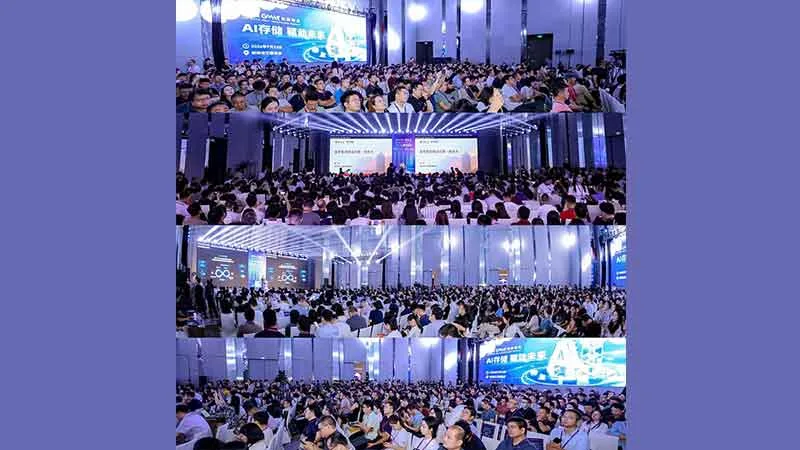
The 5th GMIF Innovation Summit (Global Memory Innovation Forum 2026, GMIF2026) recently concluded in Shenzhen. Co-hosted by the Shenzhen Memory Industry Association (SMIA) and Peking University’s School of Integrated Circuits, the summit was themed “The Future Built on AI Memory and Storage,” with discussions spanning technological innovation, industry trends, and real-world AI applications.
The summit opened with remarks from Rixin Sun, President of the SMIA, who noted that as AI shifts from generative to agentic, inference efficiency and system coordination have become shared priorities, and GMIF will keep building a more diverse global platform for the AI value chain.
Daniel Yen of Morgan Stanley projected that AI capex continues to climb, with more than half of cloud data center capex expected to go to memory and storage (excluding HBM) by 2027. Prof. Yimao Cai from Peking University pointed to HBF and heterogeneous architectures combining HBM, NAND, and RRAM as a way to balance performance, capacity, and cost.
Kevin Yoon from Samsung outlined progress on Z-NAND, PCIe Gen6 SSDs, and ultra-high-capacity data center SSDs. Sandisk highlighted NAND’s expanding role in AI infrastructure and QLC adoption, while Solidigm showed how pairing high-capacity QLC SSDs with high-performance storage enables memory offloading and data tiering. Arm emphasized that inference demands holistic optimization across compute, memory, storage, and data movement.
Moving from cloud to edge, Silicon Motion shared that devices are the ultimate carrier of AI experiences, and its PerformaShape technology allocates resources flexibly across agents to improve read/write consistency. BIWIN mentioned that scenarios from data centers to on-device applications each call for distinct memory and storage, and it is leveraging full-stack capabilities for customized solutions.
Token Factories Move Enterprise AI from Pilot to Production
Lenovo ISG China introduced the “token factory” concept, describing how enterprise AI is moving from compute buildout to systematic operations. Numbers Law and NEXWISE showed how storage hardware connects to compute scheduling and model operations. Infplane and Genstoraige lowered the barrier to on-device large models through AI SSD tiering, while OKN Technology addressed test equipment for PCIe 6.0 SSDs under real-world workloads. SYNCORE, Dify, and Paratera advanced vehicle-cloud intelligence, private AI agents, and MaaS platforms.