
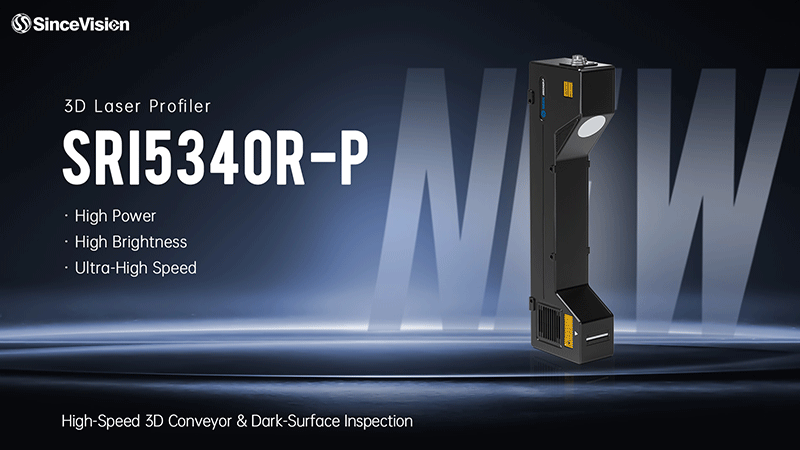
SinceVision, a global manufacturer of 3D vision, industrial sensors and high-speed cameras, has launched the SRI5340R-P, an all-in-one 3D laser profiler designed to detect conveyor belt tears and surface damage in demanding industrial environments. The new sensor, the first model in the company’s SRI5000 Series, targets applications such as underground coal mining, ports, steel mills, power plants and logistics facilities, where conveyor belt failures can cause unplanned downtime and safety risks.
The SinceVision SRI5340R-P is the debut model in the SRI5000 Series of all-in-one 3D laser profilers, designed for mining conveyor belt inspection and high speed conveyor belt tear detection. Combining a 636 nm Class 3B high power laser, a 200 μs exposure time, scan speeds up to 67,000 Hz, a 350 mm working distance, and a 580 mm reference X-axis field of view, it captures reliable 3D Vision profiles on dark rubber belts moving at 3.5 to 5 m/s even through 10 to 12 mm of explosion-proof glass.
Solving Harsh Industrial Conveyor Belt Inspection Challenges
In heavy bulk handling environments such as underground coal mines, conveyor belts operate continuously under intense tension, friction, dust, and water stains. Contact based monitoring devices risk creating additional friction and wear, making non contact 3D Vision essential for preventative maintenance.
Traditional 3D laser solutions often struggle in mining conveyor belt inspection when sensors must measure dark, low reflectivity rubber belts through 10 to 12 mm of explosion-proof glass. Insufficient laser power causes severe point drop off at both ends of the profile, while raising sensor gain to compensate causes background noise to spike, reducing inspection stability and accuracy.
How the SRI5340R-P Enables Reliable Mining Conveyor Belt Inspection
The SRI5340R-P overcomes these field bottlenecks through dedicated optical and high speed imaging performance:
-
Non contact tear prevention: Line laser 3D Vision measurement inspects belt surfaces without physical contact, preventing any sensor induced belt wear.
-
High speed scanning without motion blur: An ultra high speed 200 μs exposure time and scan rates up to 67,000 Hz prevent image smearing on fast moving lines. In coal mine deployments running at 3.5 to 5 m/s, operating at 4,300 Hz maintains submillimeter spacing between adjacent sampling points so longitudinal tears, transverse tears, and belt breakage are captured without frame drops or missed defects.
-
Dedicated dark material and glass penetration: A high brightness, high power 636 nm Class 3B laser and built in light source penetrate 10 to 12 mm explosion-proof glass without external supplemental lighting, maintaining stable imaging in dark underground tunnels, high dust environments, and wet belt conditions.
-
Full width coverage under continuous vibration: Wide X-axis and Z-axis optical coverage scans full conveyor widths, while high repeatability keeps inspection data stable despite continuous belt vibration and complex surface conditions.
“Conveyor belt failures in mines, ports, and steel mills lead to costly unplanned downtime and serious safety risks,” said Jack Li, Global Sales and Marketing Director at SinceVision. We engineered the SRI5340R-P to overcome the toughest optical barriers in heavy industry, giving operators reliable 3D laser inspection on fast moving dark belts even behind thick explosion-proof glass.”
Field Validation: Coal Mine Conveyor Belt Inspection Results
During field validation for mining conveyor belt inspection, the SRI5340R-P was evaluated against strict operational detection requirements:
-
Tearing: Depth greater than 70% of belt thickness and length greater than 30 cm across belt thicknesses of 10 mm, 12 mm, 20 mm, and more.
-
Surface Damage: Length greater than 3 cm and depth greater than 1.5 mm.
-
Foreign Objects: Detection of rod or columnar foreign objects and identification of metal fasteners on the belt.
At a 350 mm working distance behind 10 to 12 mm explosion-proof glass in a dark, dusty environment, the SRI5340R-P generated real time laser spot grayscale value analysis charts with an overall grayscale value of approximately 160. This verified normal belt surface reflection, intact rubber coating, and dependable data consistency under extreme conditions.