

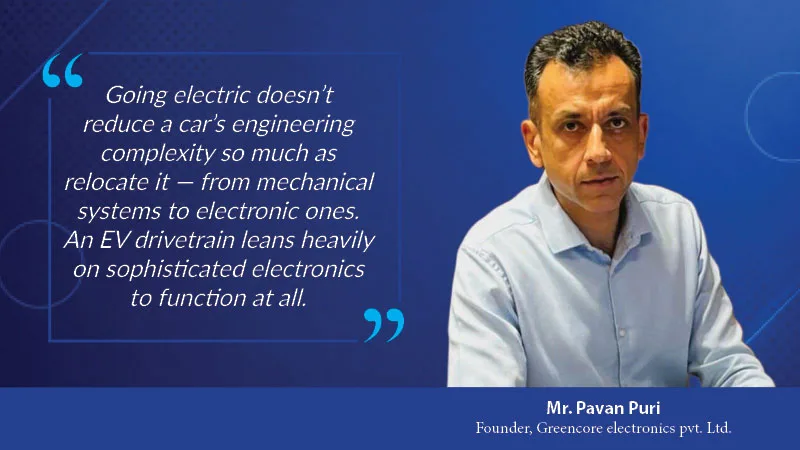
Mr. Pavan Puri, the founder of Greencore Electronics Pvt Ltd, laid emphasis on automotive cars. In this article, he highlights the importance of software-defined vehicles and discusses the future of cars.
Increasingly, a car is a computer you happen to sit inside. Driver-assist systems, connected infotainment, battery management, telematics, digital dashboards, onboard security — electronics now touch nearly every part of how a vehicle is designed, built, and driven.
None of this makes mechanical engineering obsolete. But it does mean the future of mobility hinges on how well mechanical systems, electronics, and software work together. The electronic architecture underneath a car is quickly becoming one of the biggest differentiators in the industry.
For India’s auto sector, that shift is both a major opportunity and a genuinely hard engineering problem to solve.
From Mechanical Machines to Software-Defined Vehicles
For most of automotive history, what a car could do was locked in at the factory — fixed by its mechanical parts and a handful of dedicated control units. That’s changing. Increasingly, a vehicle’s features can be updated, expanded, or personalized after the fact, through software.
That shift is reshaping how vehicles get built in the first place. ECUs, sensors, processors, communication networks, and embedded code now matter just as much as pistons and gearboxes.
A single car might run dozens of electronic systems talking to one another — tracking performance, battery health, driver behavior, road conditions, even passenger preferences — and crunching all of it in real time.
That changes the development process too. Automakers and suppliers can’t treat electronics as a bolt-on subsystem anymore. It has to be part of the architecture from day one, with hardware, firmware, software, sensors, and networking designed together rather than stitched together later. For engineering firms, that means pairing hardware know-how with embedded software, systems integration, and product engineering under one roof.
ADAS Is Rewriting the Rules of Vehicle Safety
Nowhere is this shift more visible than in Advanced Driver Assistance Systems. ADAS leans on cameras, radar, LiDAR, ultrasonic sensors, and a web of control units and algorithms to make sense of what’s happening around a car.
Lane departure warnings, adaptive cruise control, blind-spot detection, automatic emergency braking, parking assist, driver monitoring — features that used to sit exclusively in luxury trims are now filtering down into everyday cars.
What makes ADAS significant isn’t just the convenience. It marks a real shift toward vehicles that can read their surroundings and help drivers avoid mistakes.
The hard part isn’t bolting on more sensors — it’s sensor fusion. A camera reads lane markings. Radar tracks distance and closing speed. Other sensors fill in the rest. Getting all of that to agree, in real time, without lag or contradiction, takes serious electronic architecture and equally serious software. That’s why electronics engineering now sits at the center of automotive safety, not on the sidelines.
Sensors Are Multiplying — and So Is the Data Problem
As cars get smarter, their ability to sense the world around them matters more and more. Sensors have quietly become one of the foundational technologies of modern mobility — temperature, pressure, proximity, cameras, radar, LiDAR, inertial sensors, battery monitors, the list keeps growing.
Every one of those sensors is a firehose of data that has to be captured, processed, and interpreted, often in milliseconds. Balancing that against power draw, cost, reliability, and heat is where product engineering earns its keep.
Consumer-electronics parts don’t simply transplant into a car. Vehicles live through vibration, temperature swings, electromagnetic noise, moisture, and years of continuous use that a phone or laptop never has to survive. So automotive electronics have to be engineered for durability from the first sketch, not patched for it later.
Electrification Raises the Stakes for Electronics
Going electric doesn’t reduce a car’s engineering complexity so much as relocate it — from mechanical systems to electronic ones. An EV drivetrain leans heavily on sophisticated electronics to function at all.
The battery management system is the clearest example. A BMS tracks voltage, current, and temperature continuously, keeping the battery healthy and safe while squeezing out performance.
Power electronics matter just as much — inverters, converters, onboard chargers, and motor controllers all decide how efficiently stored energy actually reaches the wheels. In other words, an EV’s real-world performance depends as much on its electronics as on its battery chemistry. As EV adoption climbs, expertise in embedded systems, power electronics, and thermal management is only going to become more valuable.
Connected Cars Are Turning Vehicles Into Data Platforms
Connectivity is the other force pulling electronics to the center of the automotive story. Modern cars talk to apps, cloud platforms, navigation services, infrastructure, and each other.
Telematics can report a vehicle’s location, diagnostics, driving behavior, energy use, and upcoming maintenance needs. For fleet operators, that translates into better routing, higher utilization, and fewer breakdowns. For everyday drivers, it means remote monitoring and more personalized features.
Zoom out further, and connected vehicles start looking like nodes in a much bigger network — talking to smart infrastructure, charging stations, traffic systems, and digital platforms.
But every new connection is also a new responsibility. A connected car has to be built not just to communicate, but to do so reliably and securely. The more wired-in a vehicle becomes, the more its electronic architecture needs to be built with security as a first principle, not an afterthought.
Cybersecurity Has Gone From Afterthought to Requirement
Automotive cybersecurity used to be a niche concern. It isn’t anymore. A car with multiple communication interfaces, cloud-connected services, and software-driven features has a far bigger attack surface than the analog vehicles of the past.
That means security needs to be baked into the development process from the start, not tacked on at the end — secure communication, authentication, access control, and protected software updates all need to be part of the architecture.
This matters even more as over-the-air updates become routine. Being able to push software improvements without a trip to the dealership is a genuine convenience, but only if the update channel itself is locked down. The automotive engineer of the future will need to think like a security professional as much as a circuit designer.
Electronics Are Consolidating Into Centralized Architectures
There’s also a structural shift underway: a move away from sprawling networks of individual ECUs toward centralized and zonal architectures. The old approach — one dedicated control unit per function — starts to buckle under its own weight as features multiply, adding wiring, weight, and software complexity.
Centralized and zonal designs simplify things by consolidating computing power and organizing electronics around zones of the vehicle rather than individual functions.
That has ripple effects across the supply chain. Component makers and engineering partners increasingly need to think in terms of system-level architecture, not just isolated parts — which opens the door for electronics and product-engineering firms to move further upstream in vehicle development.
Can India Become an Automotive Electronics Hub?
India has long been known for automotive manufacturing scale, engineering talent, and a large domestic market. The next frontier is automotive electronics and electronic product engineering specifically.
The building blocks are already here — a growing ecosystem of automakers, component suppliers, electronics firms, semiconductor players, software developers, and engineering service providers. But manufacturing capacity alone won’t get India there.
What’s needed is depth in R&D, prototyping, embedded software, testing, validation, functional safety, and systems engineering. There’s also a genuine edge to be found in designing for Indian conditions specifically: extreme heat, rough roads, dense urban traffic, and a wide range of consumer needs. Electronics built and tested for that environment tend to travel well to other emerging markets facing similar challenges.
Product Engineering as the Real Differentiator
As vehicles get more complex, the line between “component supplier” and “technology partner” keeps getting more important. Product engineering firms are the ones that can actually carry an idea through to a viable electronic product — concept, electronic design, embedded software, prototyping, validation, testing, and production support.
For a company like Greencore Electronics, that broader product-engineering role is the opportunity: helping the industry move from mechanical platforms toward intelligent electronic systems, across ADAS, telematics, connected-vehicle systems, and the other areas where hardware and software now overlap.
The goal was never to build one more electronic component. It’s to build systems that hold up reliably inside the demanding environment of a moving vehicle.
Reliability Matters as Much as Innovation
One of the more common misconceptions about automotive tech is that innovation just means adding features. In reality, it just as often means making things bulletproof.
Nobody minds much if a phone app crashes once in a while. A safety-critical electronic system in a car doesn’t get that kind of slack. That’s why automotive electronics go through such rigorous testing — hardware has to survive real-world stress, and software has to behave consistently across a huge range of conditions. Functional safety, electromagnetic compatibility, heat tolerance, long-term durability — all of it has to hold up, which demands a different engineering mindset than consumer electronics typically requires. The companies that win here will be the ones that treat innovation and discipline as the same job.
The Car of Tomorrow Is an Integrated Electronic System
No single technology will define the next decade of automotive innovation. It’ll be the convergence of all of them — electrification, connectivity, ADAS, sensors, embedded computing, software, cybersecurity, and smarter vehicle architecture, working together.
The engine isn’t going away, but it’s no longer the center of gravity. Increasingly, what sets a vehicle apart is how well it senses its environment, processes information, communicates, and responds.
That shift is reshaping the whole value chain, too. Semiconductor makers, electronics developers, embedded software specialists, systems integrators, and product engineering firms are becoming just as important to automakers as their traditional parts suppliers.
For India, that’s a meaningful opening — a chance to move beyond being simply a large market for cars and become a genuine contributor to the technology inside them, built not just on factory floors but in engineering labs and software teams.
The car of the future will probably still have four wheels, a steering wheel, and a powertrain. But its intelligence will live in the electronics underneath.
The next wave of automotive innovation isn’t about building a better engine. It’s about building vehicles that can sense, think, communicate, and respond — and electronics will be doing most of that work.